

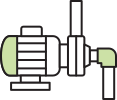
Simple Replacement of Water Pump Systems with Constant Speed up to 75 kW
Pumps
Measure Goal
The goal is to estimate the electricity savings triggered by the simple replacement of water pump systems with constant speed up to 75 kW without demand analysis. The pump is simply replaced by a new pump designed for the same nominal operating point. The efficiency gain results from switching to a new pump generation (better MEI) and possibly a new motor.
Examples and Scenarios
Replacement of two pump systems (ESOB, single-stage) with a constant flow rate of 400 m³/h at a height of 15 m, operating 18 hours per day. The 4-pole drive motors have a rated power of 22.5 kW and are from the year 2002.
Inputs
2x Pumpen, 22.5 kW Motor (4-polig, Baujahr 2002), 6'570 h/a
Requirements
Only measures that meet the requirements of the Energy Ordinance (SR 730.01; EnV) can be credited. The additional requirements for the technical characteristics and for the implementation of the measure are set out in Table 1.
| Old system | New system | |
|---|---|---|
| Technology | This measure applies to water pumps including motors with a rated power Pnom (at the shaft) of up to 75 kW that fall within the scope of Annexes 2.9 and 2.7 EnEV. | |
| Energy efficiency | - | The new components of the drive system must meet at least the following limit values according to EnEV: Pumps MEI > 0.7 Motors Class IE4 |
| Replacement of the drive motor | The drive motor must be replaced together with the pump if the age of the motor exceeds the following values: Pnom ≤ 5.5 kW 8 years 5.5 < Pnom ≤ 20 kW 10 years Pnom > 20 kW 14 years | |
| Sizing | The total installed rated power of the new system must be less than or equal to the total installed rated power of the old system | |
| Implementation | The replacement and commissioning of the new system must be carried out by a qualified specialist or company. | |
| Disposal | The consumption-relevant components of the old devices may not continue to be operated within Switzerland. Proper disposal or export must be demonstrable on request. | |
Proof of compliance
Compliance with the requirements must be demonstrated by the following documents. The documents listed in Table 2 are an integral part of the proof of measure implementation.
- 1.Explanation (PDF format, max. 2 A4 pages) of how it is ensured that the replaced devices were properly disposed of (e.g. by means of declarations, disposal items on contractor invoices, etc.).
- 2.Invoice documents (PDF, PNG or JPEG format)
- 3.Photos (PDF, JPEG or PNG format) of the old and the new installation, including the rating plates of the devices (pumps and motors)
Would you like to submit your project or need help?
ContactSymbols, Terms and Units
| Symbol | Description | Unit |
|---|---|---|
E | annual electricity consumption | kWh/a |
ΔEeco | cumulative electricity savings | kWh |
f | Factor | — |
Ns | Standard effective duration | a |
H | Height | m |
Δp | Differential pressure at pump connections | kPa |
Ph | hydraulic power | kW |
Pm | mechanical power | kW |
t | annual operating hours | h/a |
Q | Flow rate | m³/h |
τ | Motor load | % |
η | Efficiency | — |
Calculation Formulas
Creditable Electricity Savings
The creditable electricity savings result from the difference between the current and the new annual electricity consumption, multiplied by the reduction factor f_eco of 0.75 and the standard effective duration N_s.
Hydraulische Nennleistung
The nominal hydraulic power is calculated from the differential pressure and flow rate, or from height, water density and flow rate.
Annual Electricity Consumption
The annual electricity consumption is expressed as a function of the nominal hydraulic power, annual operating hours and the nominal efficiency of the pump and motor.